La veuve Couderc (1971)

August 25, 2017


For the Journeys in Classic Film 2017 Summer Under the Stars Blogathon, I decided to write a bit about La veuve Courderc, a quiet French drama starring Alain Delon and TCM's star of the day Simone Signoret.

La veuve Courderc begins with a mustached Alain Delon wandering into town, just as Simone Signoret is attempting to carry her heavy egg incubator to her farmhouse down the road. Signoret is "La veuve" --or the widow-- of the title. She lives with her grumpy (and, if the subtitles on my copy are an accurate translation, abusive) father-in-law, and just across the river from her judgmental sister-in-law. When she takes on Delon's mysterious drifter as a hired hand on her farm, it stirs up trouble with the sister-in-law and her young attractive daughter, played by Ottavia Piccolo.

That might all seem like a pretty soapy plot but overall it's actually a very soft, slow-paced movie with nuanced, sensitive performances. Delon plays a very Delon-like character -- enigmatic, morally ambiguous, and quiet yet volatile. Even when he finally shares his secretive backstory you're still not entirely positive that he's telling the truth. And when the widow takes a liking to him, you're never quite sure if his reciprocated feelings are genuine.

While Delon is -- unsurprisingly -- my favorite part of the movie, Simone Signoret does most of the heavy lifting here. The events of the movie may be set into motion when Delon arrives in town, but his role is mostly that of an object of desire and an enigma that nobody can quite figure out. Signoret bears the brunt of the town gossip, and she endures the heartbreak when the drifter favors her young niece over her, even telling her to her face that he preferred the niece because of her youth. The film really tries to play up the age difference (in real life Signoret was 50 while Delon was 36) with Signoret's graying hair, matronly nightgowns, and world weary composure; juxtaposed against her mischievous, spirited niece exposing her chest to breastfeed her infant in front of an attentive Delon.

Signoret may be playing up the age with her appearance, but inwardly her performance is that of a lovestruck teenager. She is glowing and giddy when he pays her attention, but she is quick to turn to vindictive acts of jealousy or get snippy with him when she suspects he's playing around with her niece. She embodies the role so well, fluctuating between girlish emotions while still somehow maintaining that cool, unflappable Signoret veneer. It's kind of like she's playing the hardened city girl with a soft center, just transposed to a French countryside setting. It's brilliant.

Finally, let's circle back to that mustache and ask the question on everyone's mind: "Is that mustache really necessary?"


I don't think it's necessary to his face, but it's probably necessary to the movie. He shaves it off about halfway in, the timing coinciding with his piqued interest in the niece. I'm not exactly disturbed by its presence during the first 45 minutes but I'm always happy to see it go ;)

Unfortunately this movie only seems to be available in DVD boxsets, most of which are region 2. It's available in this Alain Delon boxset which is a little pricey but I highly recommend it if you're a fan of his work. It contains a few other movies that are difficult to find in America and it's region 1 so it will play in American DVD players!

Summer Movie Blogathon: La Piscine (1969)

June 24, 2017


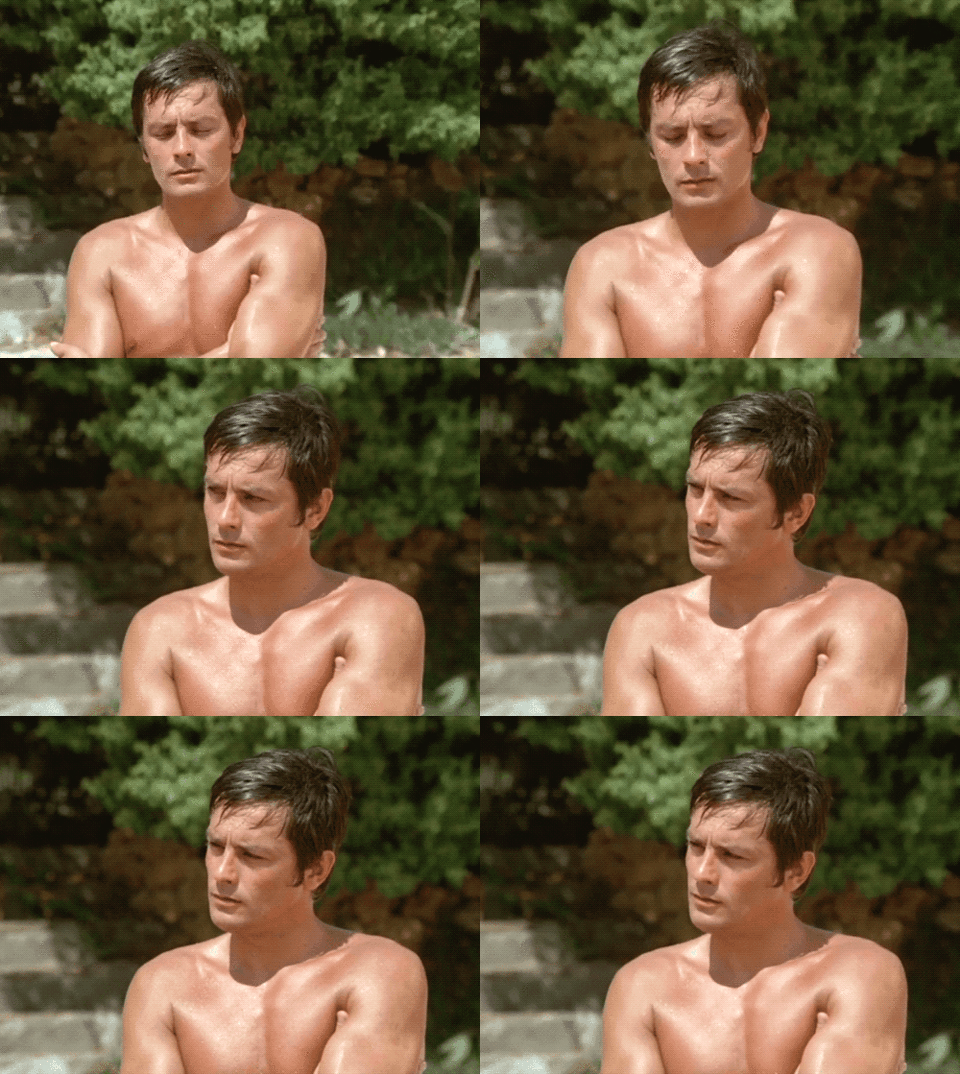
For the Summer Movie Blogathon, I decided to pay tribute to my favorite summer flick, La Piscine (1969) starring Alain Delon, Romy Schneider, Maurice Ronet, and Jane Birkin.

Lots of movies take place in the warmest season of the year, but few of them manage to capture the sizzle, the heart-palpitating heat, the gentle buzz of insects, the rapture of flesh slowly baking in the sun. When you watch La Piscine, you can feel that late 60's French summer radiating through the screen; it roasts your skin and leaves you aching to dive into the pool with Romy and Alain. I suffer a form of cinematic heat stroke each time I watch it. It paralyzes me completely.


Romy and Alain play a seemingly content couple, Jean-Paul and Marianne, vacationing at their friends' villa for the summer. Spending their days swimming in the pool, laying next to the pool, kissing beside the pool, and kissing in the pool (see above) they're the picture of luxurious sun-kissed bliss. As Millie said when I forced her to watch it, "Romy just changed from her swimsuit into ANOTHER swimsuit. I love this movie."

But all of that changes when Jean-Paul's old friend Harry (who is possibly Marianne's ex-lover... hmm...) played by Maurice Ronet, turns up unexpectedly with his barely-legal daughter Pénélope, a young Jane Birkin in one of her first roles. And that's when the summer sizzle turns into a full-blown fire. Raging jealousies and coy flirtations give way to an unexpected plot twist that turns this slow steamy flick into a fiery suspenseful thriller!

I've seen a lot of complaints that this movie is too slowly paced, or too (God I don't even want to type this word) boring, but it is so incredibly full of innuendo, side-eyes, subtle glances, scorching resentments, and dangerous mind games. Harry constantly makes little digs at Jean-Paul, while Marianne decides to fuel the gossip mill and play the coquette with her rumored ex-lover. Meanwhile Pénélope meanders aimlessly around the villa, alternately lounging in the sun to escape an oppressive case of teenage boredom, and indulging the advances of a romantically frustrated Jean-Paul.


La Piscine has the honorable distinction of being the second most-watched movie I've logged since I started keeping track of my movie-watching habits on Letterboxd in 2015. I've seen it seven times in the last 1.5 years (at one point last year I was watching it once a month!) and I still feel like each time I watch it I pick up on another passive-aggressive remark or a sly exchange. I've seen it so often now that sometimes I watch it without the subtitles and just pay attention to their expressions, how the actors react to each other and how the camera often slides slowly from one person to the other as if to say "et, tu?" after a particularly blistering burn.

Sometimes I revisit La Piscine for the summerness itself -- when our heater broke in mid-February 2016, it was a welcome respite from the frosty air. I swear I felt palpably warmer, as if the rays of the sun had reached into my arctic abode and physically enveloped my body in La Piscine's warmth.

But usually I return more for the torrid romance, the sweltering glances, the pressure-cooker of envy and blazing emotions, the fevered innuendo. While the scorching summer sun is essentially a co-star in the film, it's the plot and the characters (and let's be honest, Alain Delon shirtless. I had to say it.) that make this movie so burning hot.


La Piscine used to be streaming on Amazon but it doesn't appear to be available anymore. The only Region-1 DVD that I managed to find with English subs came as part of an Alain Delon boxset, available here. If you're a Delon fan I highly recommend it. I especially love The Widow Couderc, which teams him with Simone Signoret. The film is also currently on youtube, albeit without subtitles.

UPDATE: Criterion has announced a 4k restoration of La Piscine, coming to DVD and Blu in July 2021. It comes with brand new English subtitle translations, an alternate ending, a documentary, and more. When I tell you that I have never ordered anything quicker in my life, I am not exaggerating.

And if you want to experience La Piscine in person (unfortunately minus Alain and Romy) the villa where the movie was filmed is now a hotel/restaurant, so you can actually swim in LA PISCINE! Between that and Frank Sinatra's Palm Springs estate, I have a lot of bucket-list saving to do!

Two Alain Delons are better than one

October 03, 2016


This post is for the Dual Roles Blogathon (It's not late if it's still technically yesterday in some time zones while I'm writing this, right?) which is highlighting films in which an actor plays more than one part. Naturally I couldn't pass up an opportunity to screencap the heck out of La Tulipe Noire (1964) in which Alain Delon plays a masked hero during the French Revolution.

The film itself is okay, it's definitely not the best adventure film out there, but it's enjoyable. Also, the US release has somewhat confusing English subtitles. But let's get real... if you're watching La Tulipe Noire, you didn't come for the subtitles:


Yeah.

To be honest I've only watched the film from start to finish once. But I've lost count of how many times I've just popped the dvd into my computer and fast-forwarded to the best eye candy scenes where Alain Delon is playing what has to be the hottest masked avenger in cinematic history.

Now that's not really much of a stretch for Alain, right? I mean, you could look at basically any candid photo of him and be like "yeah, definitely the hottest masked avenger of all time." He doesn't even need to DO anything, he just oozes "hot masked avenger."

So that's where the acting and the dual roles come in. Because in addition to playing Guillaume de Saint Preux, The Black Tulip, hero of the French Revolution, he is also playing this guy:


When the hot masked avenger gets injured on the job, he asks his brother Julian to cover for him. Guillaume has a whole Scarlet Pimpernel/Zorro situation happening-- he's a respected member of society who needs to keep his heroic antics under wraps. If he attends a social function with a giant gash on his face, the guy who caused it will obviously know he's The Black Tulip.

So sweet, innocent, pure little cinnamon roll Julian takes his place. He is so delicate and nice and awkward that, I kid you not, whenever the story was following him I'd be like "ugh, bring back Alain Delon!" That's how good Alain Delon is. He was literally right in front of me on the screen and I forgot it was him. Because hot masked avenger Alain Delon was nowhere to be seen.


Look at them, they don't even look like the same person. The Black Tulip is confident and manages to make a ponytail tied with a ribbon look like the most macho hairstyle that ever was. Julian, meanwhile, is buttoned up to the neck in a pilgrim ensemble like "gee, shucks, Guillaume, I sure wish I was as cool as you are!"


"we are literally the same person but I am still staring at you in awe because you are such a perfect specimen"


The film was based on a novel by Alexandre Dumas, but apparently (I haven't read the book) the only thing they have in common are the names of the characters. So if you're looking for an accurate adaptation, you'll have to look elsewhere.

But I'm pretty sure if you're watching La Tulipe Noire, you were looking for something else:


(more screencaps after the jump!)

The Classic Movie History Project: John, Juliet and Hayley Mills

August 10, 2016


John, Juliet and Hayley Mills

For the Classic Movie History Project this year, one of the topics is "The Family Business" and I jumped at the chance to cover my favorite movie dynasty, The Mills Family. Hayley Mills has been one of my favorite actresses since I was a child. I always consider my entrance into the world of classic film fandom to be my obsession with Audrey Hepburn that hatched in December 1999, but if I'm being particular, Hayley Mills was actually my first foray into the world of classic cinema. I was watching The Trouble with Angels and The Moon-Spinners while the rest of my elementary school classmates were hooked on the Teenage Mutant Ninja Turtles.


John and Hayley

Over time I discovered her father, Sir John Mills, a phenomenal British actor who had started making movies in the 1930's, and kept at it until he passed away in 2005. Her older sister Juliet also acted, with most of her success being in television (although my own favorite role of hers is in Billy Wilder's Avanti!) All three Mills family members constantly delivered top-notch performances, whether starring in a David Lean-directed Dickens adaptation, a live action Disney film, or even an unsettling low-budget horror flick.


John, Juliet, Hayley and Jonathan Mills

...I've been thinking lately about how to fully express my love of classic movies, some way I can share my passion for them that doesn't really involve writing. I mean, I want to keep writing here, but my way with words is neither special nor eloquent in any way. I always run into a roadblock when it comes to translating my feelings about film into words and sentences. I'm currently reading a biography of Francois Truffaut, and the excerpts from his reviews at Cahiers du Cinema are leaving me even more critical of my own scholarly shortcomings.


Juliet, Hayley, Jonathan and their mom Mary Hayley Bell

Anyway, all of this has been sloshing around in my brain, all the while I knew I wanted to write something up for this post. It isn't quite enough to tell you that I love Hayley, John, and Juliet. As far as Hayley goes, everything I think becomes too personal -- why she is important to me, how her films shaped my whole life, how I've spent almost three decades aspiring to BE her character in The Trouble with Angels. Of John I can only say that he is one of my all-time favorite actors (speaking of linguistics, please tell me there is another term for "all-time favorite" so I can stop saying it ad nauseam) and his performance in Hobson's Choice is so delicately perfect, so sweet and beautiful that just thinking about it almost makes me cry. Juliet is the most underrated Mills, I think, and deserves so much more recognition than she currently enjoys. Please just watch her in Avanti!. She is at once lively, self-conscious, adorable, and full of grace. I'm usually critical of Billy Wilder's casting decisions, but in Avanti! he knocked it out of the ballpark.


John Mills and wife Mary Hayley Bell

Since I really don't think I can contribute much in the way of words, I decided to scan some of my favorite family photos from John Mills' autobiographical photo book, "Still Memories." I love that these are authentic family snapshots, not staged photos (with the exception of John and his wife, Mary Hayley Bell, eating ice cream in Hollywood. That one is a publicity portrait) My personal favorite is the following, with John and Juliet wearing fake mustaches!


John with his father, Lewis Mills, celebrating the birth of Hayley Mills.


The caption for this photo is one of the sweetest things I've ever read. John Mills writes, "I was on a 48-hour leave. I had the date of my marriage engraved on my Reverso watch, 16.1.41, which was quite unnecessary. I have never needed reminding of the most marvelous day of my life."


John Mills with tiny Juliet Mills in front of their home, Misbourne Cottage in Denham Village. According to the book his neighbors included David Lean, Noel Coward and David Niven!


Hayley Mills' christening, with her parents and Martha Scott.


It may be a publicity portrait but this is one of my favorites from the bunch. So adorable!


Hayley Mills with her parents and Sir Laurence Olivier after the premiere of Tiger Bay


Ice Cream Social blogathon: Sunday in New York (1963)

May 20, 2016


When I saw that Movies Silently was hosting a Classic Movie Ice Cream Social Blogathon, spotlighting movies with the "power to cheer you up when you’re feeling down," I knew I HAD to blog about Sunday in New York. It's a comedy from 1963 starring Jane Fonda, Rod Taylor, and Cliff Robertson, and it's been my favorite movie for about six or seven years.

I feel like we've been together forever though. I've seen other movies that I like better, or (obviously.. I mean, it's a 60's sex comedy, it's not Citizen Kane) movies that are just better movies. But something about Sunday in New York stuck with me; it is my filmic comfort blanket. It's like a cup of tea and a book during a thunderstorm, a shoulder to cry on on a bad day, a scoop of ice cream on a hot summer afternoon.

I've seen Sunday in New York countless times, so much in fact that sometimes I'll try to play the movie in my mind, running through each scene and seeing how much I can remember (The answer here is "all of it," something that's either very impressive or very embarrassing.) I had the immense pleasure of seeing this on the big screen at the 2014 TCM Film Festival, introduced by Robert Osborne in person. I cried happy tears afterwards, it was such a moving experience for me. And last year when I got a portable projector and movie screen for the backyard, deciding which movie to pick for the inaugural screening was a cinch.


So what is it about Sunday in New York that makes it so great? Why is this the movie that, above all else, cheers me up when I'm feeling down? I can give you a list of reasons (and I will, in a second) but, I think our relationships with movies are similar to relationships with people (stay with me) in that we each have our own chemistry with film. Sunday in New York appeals to me, it set off a spark in my brain that's impossible to quantify. I fell in love with it, and despite any attempts to make sense of my infatuation, I've come to accept that it just is. You can't help who/what movie you fall for, sometimes it's Alain Delon, sometimes it's a very silly slightly sexist 60's romantic comedy that's also kind of an ad for Peter Nero. If that sounds like it might be your cup of tea (or ice cream cone!) too, here are some reasons why I think Sunday in New York is awesome:

- If you have to escape for a few hours to a different reality, escaping into one that takes place in this apartment is a very good idea.

- It utilizes a lot of standard rom-com devices, but in a very fresh way. Jane Fonda and Rod Taylor have not one, but TWO very cute meet-cutes. And there is your standard confusion-arising-from-misunderstandings but it's hilarious, not eye-roll worthy. And while a few complications-to-move-the-story-forward happen, they don't last long. When you're watching a movie to cheer you up, you don't want to experience any of those frustrating movie moments that get you yelling at your screen.

- It talks about sex, double-standards, and the pressure of expectations on girls in a very frank way (albeit laced with some sexism that's to be expected from this type of movie from this particular era)

- There's a second storyline involving Cliff Robertson and Jo Morrow that's almost as funny and adorable as the Taylor and Fonda plot. (Sidenote: if anyone doubts Robertson's sex appeal, watch him answer Morrow's complaint that it's cold in Denver with the line "I guarantee that will not be your problem...." Yeesh!!)

- The cast members have an excellent rapport with each other. Jane Fonda and Rod Taylor make a fantastic pair and really should have been their generation's Doris Day and Rock Hudson (Taylor was actually paired with Day a couple times but I feel like he works so much better with Jane Fonda.)

- If you don't like Peter Nero, this isn't really a plus, but it's basically an ad for Peter Nero. Fonda brings Robertson's character one of his albums as a gift, Fonda and Taylor discuss the new Nero album on their date, he orchestrated the soundtrack for the movie, and when they go to a nightclub I'll give you one guess who's there performing live. Go on, guess! ;) I like it, though, I think it's kind of a throwback to the 30's and 40's when a lot of movies would feature a band leader like Ray Noble or one of the Dorsey brothers.

- It's a feel-good movie. If you know me, it might actually be a shock that I'd choose a feel-good movie to cheer me up, lol! My friends literally preface recommendations with "It's depressing, you'll love it!" But as much as I might like my films dark, morbid, and gloomy, when it comes to my "ice cream social" movie, I want something that leaves me grinning like an idiot when it's over. Sunday in New York is planted firmly in happy-ending, smiles for days territory, and I wouldn't have it any other way.

Beyond the Cover blogathon: Jules and Jim (Part 1)

April 10, 2016


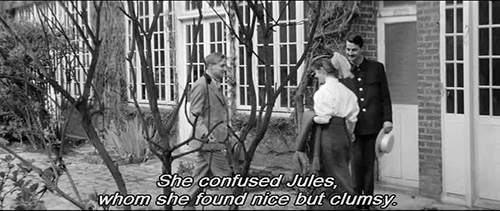
For the Beyond the Cover blogathon, I decided to read Jules and Jim by Henri-Pierre Roché. Unfortunately, like pretty much everything in my entire life, I was very well-intentioned but planned very poorly. As of this post, I only managed to finish the book's introduction by François Truffaut and the first few pages of the story. So, in an effort to still get a post up in time for the blogathon, I decided to break this up into two parts. Today I will be covering Truffaut's relationship with the book and its author. My second post will be a more detailed review of the book and how it stacks up against its cinematic counterpart.


François Truffaut happened upon the book in 1955 while perusing second-hand books at Le Palais Royal in Paris. The title "Jules et Jim" initially caught his attention, but upon reading on the back of the book that this was the debut novel from a 76 year old author he was especially intrigued: "What can a first novel written by a septuagenarian be like?"

By the first page, Truffaut had already "[fallen] in love" with Roche's writing. And this admiration is evident in the fact that Truffaut's film opens with a voice-over lifted practically word-for-word from the book:


A few months after reading Jules and Jim, Truffaut mentioned the novel in a review of The Naked Dawn, writing "One of the most beautiful modern novels I know is Jules et Jim by Henri-Pierre Roché, which gives us the lifetime of two friends and their companion in common, who love each other tenderly and with almost no clashes, thanks to a new and aesthetic moral ethic which is constantly under review. The Naked Dawn is the first film to give me the impression that a cinematographic Jules et Jim is possible."

Roché saw the review and responded, striking up a correspondence that would last until Roché's death in 1959. Before Truffaut had even begun work on his first movie, The 400 Blows, he mentioned in one of his letters that he would love to make a film version of Jules and Jim, and Roché approved of the idea -- they planned for Truffaut to eventually write the treatment & Roché the dialogue.

Unfortunately, Roché passed away before they had a chance to begin working on a script. But in the days before his death, he did get to see, and approve of, Truffaut's choice of actress for the role of his heroine, Kate (referred to as "Kathe" in Roché's letter and changed to "Catherine" in the film.) In his last letter to Truffaut he writes, "Dear young friend, your wonderful letter! ... Many thanks for the photos of Jeanne Moreau. I like her. I am happy that she likes Kathe! I hope to meet her some day, yes, come and see me when you like, I'll wait for you." Truffaut received the letter on April 5, 1959. Roché passed away four days later.


Truffaut began work on the film in 1961, but he was haunted and restless -- feeling guilty that he had put off the project for so long that Roché was no longer there to oversee production and constantly turning to the book for guidance, he "often found [himself] pushing the screenplay to one side and opening [his] copy of the novel again, making a note of several splendid phrases to 'preserve intact' and integrate into the soundtrack of the film."

Despite all of the praise and accolades Truffaut received when the film was finally released in 1962, he was still wracked with guilt, writing, "Henri-Pierre Roché was no longer there to harvest the fruits of his tree, and that was beginning to torment me. I was convinced that I was too young to make with the camera what Roché had drawn with his [pen.] The exact thing which I had most admired on reading the book was the fifty years of retirement between the living of the events and the author's narration of them... I was less than thirty years old when I made Jules et Jim, and I had forced myself to make not a young film, but quite the opposite -- an old man's film, and I wasn't sure I'd pulled it off!"

Writing this introduction in 1980, almost 20 years after the making of the film, it's clear that Truffaut's relationship with the author, and the sadness attached to making the movie after Roché had died, had plagued him for most of his life.

I can't speak to the authenticity of Truffaut's adaptation, since I have yet to finish the book, but from their correspondence it would seem to me that although Roché died without ever getting the chance to see his characters come to life on screen, he must have left this world thinking that if the movie version ever came to pass, it would be in good hands with Truffaut. And based on Truffaut's devotion to the author and his sensitivity to making sure that his film truly captured everything that he loved about the book, I have no doubt that all of his torment was for nought.