Anthony Perkins was not Norman Bates

January 09, 2010


About nine years ago I saw The Man with the Golden Arm for the very first time. I was only a year or so into being a huge movie fan, and so for almost every film I watched I was seeing the stars acting for the first time. My first encounter with Eleanor Parker was as a conniving, deceitful, whining, nagging wife to Frank Sinatra -- who was the be-all and end-all of my movie obsession at the time. Having seen none of her other performances, I immediately determined that she was a conniving, deceitful, whining, nagging person and I'd avoid all of her films from there on in.

What I failed to realize at the time (don't worry, it didn't take me nine years to discover this) was that if an actor irritates you, creeps you out or disgusts you in a movie it might just mean that they are a really good actor, perfectly playing the role in which they were cast.

The character of Zosh in The Man with the Golden Arm is supposed to be hated by the audience-- she is supposed to be low and despicable. And Eleanor Parker did a marvelous job of portraying that. But because of my sheer ignorance, I assumed that Eleanor Parker was Zosh.

Each of us probably has had this happen with one or two actors -- sometimes it's simply a subconscious association of an actor with a specific part that turns us away from their entire filmography. Sometimes we assume that an actor or actress exhibited the traits they portray in film in real life -- for instance, many people are usually shocked to find out that Boris Karloff was a real teddy bear of a man offscreen-- one of the sweetest Hollywood has ever seen -- because he was typecast as monsters onscreen.

In my experience, the one person who has become a victim to this psychology more than anyone else is Anthony Perkins. His name goes hand in hand with Psycho-- mention it and people automatically picture him wearing a grey wig and a matronly stuffed dress, or wrapped in a blanket with a fly buzzing around his head. Unfortunately, this mental roadblock prevents people from realizing what an amazing actor he was. He played Norman Bates so well that the character seemed real. But watch him in Goodbye Again, playing a totally different sort of man, and you'll see no trace of Hitchcock's villian.

Another fine example is James Mason. (Casey, Millie & Terry... pay attention!) He was awfully good at playing the creepy guy in Lolita and Georgy Girl, but he was equally adept at playing relatively normal characters in The Wicked Lady, Julius Caesar and Odd Man Out. It is because he was such a fine actor that his pedophelia in Lolita is believable. In reality, Mason was a caring, sweet man with an enormous soft spot for animals. He and his wife co-wrote a now out of print book called "The Cats in Our Lives" -- something I'm dying to own one of these days!

In the end, I think we need to realize - and remind ourselves- that the people in the movies we watch are actors. They are reading a script and performing. If their character is dastardly, or even sticky-sweet, that doesn't neccessarily mean that they were in real life. And if they play a psychopath in one film, it doesn't mean that they will in all of their others.

This doesn't mean we can't not like certain performers... I for one have at least a dozen or so least-favorites. But I've watched their films often enough to realize that it is them -- their mannerisms, their style of acting or their personality that bothers me-- not the character they were playing.

You might discover more fantastic actors and actresses out there, if you just keep in mind that Eleanor Parker was not Zosh, Boris Karloff was not Frankenstein, James Mason was not Humbert Humbert and Anthony Perkins was not Norman Bates.

Classic film caricatures

January 07, 2010

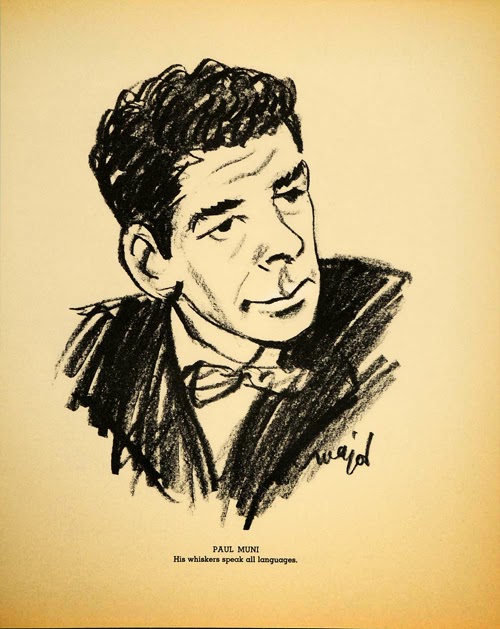
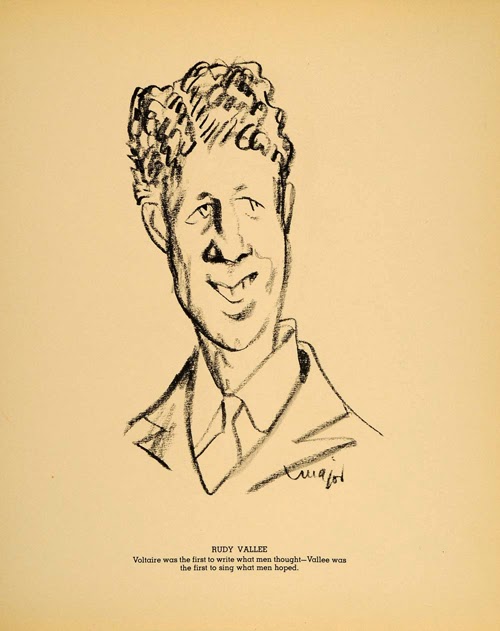
I love it when I'm trying to find a photo on google and end up stumbling upon something not even remotely related to what I was looking for, but even better! This happened to me today when I was searching for photos of Reginald Owen for an upcoming post. In the image results, I saw a small vintage caricature of Reggie that piqued my interest, even though I was only looking for photos.

Once I clicked over to the source site I discovered that someone had scanned an entire book of caricatures of classic Hollywood stars, character actors and filmmakers by Henry Major. Some of these are pure genius, so I just had to share them!! While I found every one of them to be spot-on and terrific, it was the supporting star portraits that I enjoyed the most.

Caricature artists always amaze me, because as long as you have some underlying talent you can draw somebody's face as it is... but it really takes something special to zero in on what makes a face different from other faces, amplify it and turn it into a cartoon. Despite the fact that these are simplified sketches, you can instantly recognize the faces -- maybe even moreso than if the artist had drawn them realistically!

I have a small sample of my favorites posted here, but to view the entire collection please visit The Gay Philosopher, the site dedicated to this artists' work!


A peek into Robert Osborne's home

January 05, 2010


The New York Times has a really fantastic interview with Robert Osborne about his New York City apartment. (well, that should be plural- he apparently has three!) Make sure you click on the slide show feature, which includes a narrated tour and close-up photos of his treasured memorabilia.

Now if I could only figure out how to get some of my classic movie artwork onto those walls...

(via)

Celluloid and Canvas - Frank Sinatra

January 04, 2010


Most people are already aware that Frank Sinatra was quite the talented individual -- he is widely considered one of the finest entertainers of the 20th century, perhaps the best singer of our time and an accomplished, Oscar winning actor. But few know that he was also a very able painter.

As someone who paints and draws for a living, I've always been interested in the painter side of Frank Sinatra. I was delighted a few years ago when I found a copy of the 1991 book "A Man and His Art" by Tina Sinatra. The book features glimpses into Sinatra's art studio and more importantly it showcases oodles of his paintings in full-color, gallery layouts.

While his singing style was quite traditional, and a good portion of his songs were already American standards by the time he interpreted them, his painting style is much more cutting edge and modern. Obviously inspired by artists like Mark Rothko and Josef Albers, Sinatra's portfolio consists mainly of large abstract pieces with huge brush strokes and geometric patterns. While I've included three of those pieces, I found his representational works displayed his talent even more, so I chose two of those to include in the post as well.

As Tina Sinatra wrote in the introduction to the book, "I don't think anybody can have as much talent as my father and not have several forms of expression. That kind of talent is like a constant flame."


All paintings and photos in this post are © the Sinatra family,
scanned by me from the book A Man and His Art.

Cliff Edwards

January 03, 2010


by Elizabeth
Guest Blogger

Very few people are aware of the film career of singer-songwriter Cliff Edwards beyond his voice work at Disney. His name won’t pop up in the history books next to the film greats. He probably won’t even be featured in a book about famous musicians. Yet there is no reason for him to have to suffer through such obscurity – he acted in over 100 films, sold 74 million records, and had over 30 chart topping hits. Careers like that don’t come around every day!

Cliff got his beginning in vaudeville and Broadway during the 1920s. He introduced some of the most popular songs of the decade and was almost always at the top of the charts. Unfortunately, he was placed at a disadvantage when it came to acting. His problem was similar to the one that many silent stars went through when the “talkies” rolled around – his voice didn’t suit his face. Except that his predicament was the REVERSE of what the silent stars were plagued with. The leading men of the silents were handsome and masculine, but a surprising number of them had squeaky or effeminate voices, speech impediments or bizarre accents. Our Mr. Edwards had a stunningly beautiful singing voice with a large vocal range, and a pleasant Midwestern accent. His voice could have guaranteed him regular parts in musicals as the dashing Romeo, but his figure was another story. Even in his first starring role in “The Hollywood Revue of 1929” it is painfully obvious that he was short (in most of his movies he was noticeably smaller than the leading lady), slightly bug-eyed, well on his way to being bald, and bearing an extra chin or two – and he was only 32 at the time. So while he could continue performing his romantic love songs on the 78s, on celluloid he was confined to character acting. And while character acting can get a person a good amount of jobs, it doesn’t make superstars.

At first he received his roles with great regularity and the parts were good. He never got lead, but he did get fairly high billing on the credits, and he had the privilege of playing sidekick to some of Hollywood’s best talent. His first major pairing was with none other than Buster Keaton from 1930-1931. He and Keaton become close friends, but they were split up by MGM after making only three films together. Part of the reason was that they were getting difficult to handle, as Keaton was a depressed alcoholic and both men were suffering from the shattered remains of nightmare marriages, and their troubles show in their work.

His personal life was now collapsing around his ears. He ended his marriage with second wife Irene Wylie in 1931 with an alimony that would give her one-third of any income that he made for life. He was now appearing in fewer movies, and as the 30s continued his parts became smaller and his credits less significant. He was bleeding money what with alimony, tax troubles, budding alcoholism, and some rather bad choices in gambling. In was inevitable that he should declare bankruptcy multiple times. Even through all that he did appear in some major films, such as “His Girl Friday” and “Gone With the Wind”, and received high praise for many of his parts.

Then came the role that resurrected his failing career. Walt Disney, in search for big talent to voice his films, hired him for the part of Jiminy Cricket in his second feature-length animated film, the highly anticipated “Pinocchio.” Disney must have been very impressed with Cliff’s performance, as during the course of the two years that it took to make “Pinocchio” the part of Jiminy Cricket was increased multiple times from only having only a few lines and the performing one song, all the way up to the part we know now, with Jiminy narrating and performing several numbers. The film was released in February 1940, and turned out to be a terrific hit, and “When You Wish Upon a Star” won the Oscar for Best Song. It was the fifth best selling song of 1940, and was recorded by several other performers, such as Guy Lombardo, Bing Crosby, and Glenn Miller and His Orchestra. As a final crowning achievement, it was inducted into the Grammy Hall of Fame in 2002. Even though the average person is much more likely to know who Bing Crosby is, it is still Cliff Edwards’ version that is remembered today.

One would assume that such a successful role and yet another chart topping hit would save his career and bring him out of his poverty. Not true. In fact, he filed for bankruptcy for the second time in 1941, just one year after the release of “Pinocchio” and the same year that he returned to Disney to do the voice of Jim Crow in “Dumbo”. In the mid to the last half of the 1940s he played the sidekick to cowboy Tim Holt in a series of B-westerns (and as any film historian knows, B-western sidekick generally means that an acting career is dead and buried.)

At this point, Cliff was broke and alone. His only form of regular work was because of his personal friendship with Walt Disney, and that was only voice work. He released a couple of children’s records, but they were as Jiminy Cricket, and not as himself. Even his autographs read “the voice of Jiminy Cricket.” He now had no identity that was not related in some way or another to Disney Studios. He spent all of his spare time hanging around the Studios, looking for a free lunch and someone to talk to. Whenever he was sick, Disney kindly paid all of his medical expenses. He did his final movie, a Jiminy Cricket short, in 1970 which was made 41 years after his first appearance on the big screen and 47 years since he made his first vocal recording. Cliff Edwards died in the hospital in 1971 at the age of 76.

Today he is bizarrely remembered and forgotten. Many people still fondly remember his “I’m No Fool” series of Jiminy Cricket shorts from the 1950s-1970s. Just about everyone could recognize his voice, all thanks to Disney. During his lifetime he was constantly employed in some form or another, which is not something that many actors can say. Besides that, he was an incredibly optimistic person, and refused to dwell on his own troubles. His greatest misfortune is that very few people know his name or his groundbreaking work in music, television, radio, and film apart from his cartoon voicing, which perfectly sums up how one little cricket both destroyed and preserved his career. So the next time you hear Jiminy singing “When You Wish Upon a Star”, remember the triumphs and struggles of the incredibly unique little man behind the kindly little cricket.

Hedy Lamarr

January 02, 2010


by Casey
Guest BloggerOn the face of it, a casual viewer might dismiss Hedy Lamarr as just another Hollywood illusion. Hedy is notorious for her dazzling beauty and was rightly tagged as The Most Beautiful Woman in Hollywood . She had a successful film career with roles ranging from the calculating native girl Tondalyo in White Cargo (1942) to the Russian zealot Theodore who steals Clark Gable's heart in Comrade X (1940). Hedy also runs a close second to marriage guru Lana Turner in the husband count with 6, and she divorced every one. While these are the facts that spring to mind at the mention of her golden name, I'd like to spotlight a side she is less famous for: her brain.

Our friend Hedy, was in fact, something of a genius. Her first husband, Fritz Mandel, was an important munitions manufacturer in Austria . Fritz was such a celebrated man, he hosted Adolf Hitler and Benito Mussolini at parties in his home. He was also a man without principles and sold his goods to all takers (a quality which eventually caused him to have to flee to Argentina ). Before his downfall, he funded research in the field of control systems for bombs. It is presumed that Hedy snooped into this research and learned about a scientific breakthrough.

The knowledge she acquired from her former husband's research department stayed with her and she started coming up with additions to the theory. Many years later, while Hedy was living in Hollywood , she started chatting with a musician neighbor named George Antheil. She shared her idea of "frequency hopping" for radio control of torpedoes with George. George was fascinated and helped her to conjure up a scheme to bring her idea to life.

Frequency hopping was a revolutionary idea at the time. It would allow a torpedo to be controlled by using what appeared to be an unplanned combination of radio frequencies. This would make it practically impossible for an enemy to tap into the control frequency, since the frequency was constantly changing with no apparent pattern. Frequency hopping was controlled through the use of perforated rolls of paper similar to piano player rolls (see the musicians influence here?).

Hedy and George were awarded a patent for frequency hopping on August 11, 1942 - the height of Hedy's film career. Next, the duo attempted to get the US Navy interested in their new weapon technology. The shortsighted reviewers found it impossible to look past the integration of music, and refused to get involved with the idea. Their loss, I say.

But, never fear - this story does not have a tragic ending. At the Sylvania Electronic Division of Buffalo, NY in 1957, the engineers took up where Hedy and George left off, seeing the incredible value in their findings. The Sylvania engineers upgraded the technology slightly and had a version of the Lamarr-Antheil communication system on US ships sent to Cuba in 1962. Today, this technology is used in cellular and wireless networks to prevent the systems from being hacked.

So, next time you flip your cell phone open to take a call or send a text, remember the glamorous Hollywood lady who helped make it possible: Hedy Lamarr, A Gal With A Beautiful Mind.

***

Casey wrote a fantastic sister post to this one on her blog, Noir Girl. It features a clip from Come Live With Me in which Hedy Lamarr demonstrates how to properly tie a turban -- and Casey dissected the demonstration step by step for the modern vintage girl :-D Here's the link!