There are many people who come to mind on October 31st if you're a classic film fan-- primarily Boris Karloff, Bela Lugosi and Vincent Price. Maybe Lon Chaney, Jr., Val Lewton, and Hitchcock, too. But tonight, when the sun goes down, the lights are turned out and I'm ready to watch a film that will make my hair stand on end-- I'm turning to Lionel Atwill.
Lionel Atwill isn't usually associated with horror, probably because, unlike Bela Lugosi and Boris Karloff, he made so many films outside the genre that he isn't immediately linked to it. But just watch him in Doctor X and try to sleep with the lights off the same night. It's not possible.
Lionel Atwill starred in the original Mystery of the Wax Museum -- I know I'll probably be burned at the stake for mentioning this (on Halloween of all days, too!) but I really prefer his to the Vincent Price version. The huge selling point is the two-strip technicolor. This process was also used on Doctor X (in my opinion, the scarier of the two) and it gives both films a deathly, greenish pallor that makes them look like they were filmed in a morgue. Of course, the other selling point is Lionel Atwill-- his performances give creepy a whole new meaning.
What I love about his horror film characters is that he isn't playing a supernatural monster. You can turn your television off after Dracula, safe in the notion that a vampire will not be slipping through your window while you're asleep. But Lionel Atwill's characters are often mad scientists or crazy people who really could exist in real life. Walk down the wrong alleyway, and you could become the next victim in his crazy experiment!
While he was also very successful in other genres and roles, (most notably playing a ham actor in To Be or Not To Be) to me he'll always be my favorite horror movie villian- a real life monster whose presence on film makes my hair stand on end!
***
I had this all written up, and ready to post when I started looking for images of Lionel Atwill on the internet. Even though he usually plays kind of creepy men on screen, I always fancied that he was a reserved gentlemen in real life. He just seemed that way. Boy was I wrong! According to wikipedia & imdb (oh-so-reliable, you know) he was famous for throwing crazy parties, and was actually arrested after a Christmas party turned into an orgy with illegal pornographic movies being shown! Lionel! He wouldn't say who any of the guests were, so he was convicted of perjury and sentenced to five years probation. Because of the scandal, he was blacklisted and worked in b-movies until he died from pnemonia in 1946. Isn't that awfully sad?!
Today Elsa Lanchester would have been 107 years old. I know it's kind of cliche for me to paint her as the Bride of Frankenstein, but how could I pass up the opportunity to paint that hair?! Besides, it's kind of fitting what with Halloween coming up in a few days.
Personally, I love the characters she played when she got older -- in Mary Poppins as the fed-up nanny, in Bell Book and Candle as a wacky witch and in Witness for the Prosecution as Charles Laughton's nagging nurse. But I also like her earlier performances with Charles Laughton, like in The Big Clock and Tales of Manhattan.
Okay, to be honest, I love every movie she's in. She was a fantastic character actress and her presence in a film guarantees that you are in for an enjoyable movie experience!
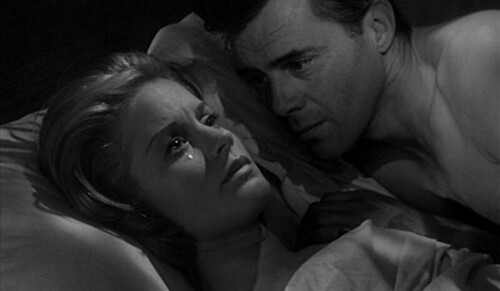
I think that generally there are two kinds of films -- films that you watch and films that you experience. The Mind Benders is definitely the latter. And during a month when "scary" is defined as monsters and ghouls, this movie scared me out of my wits without one hint of the supernatural.
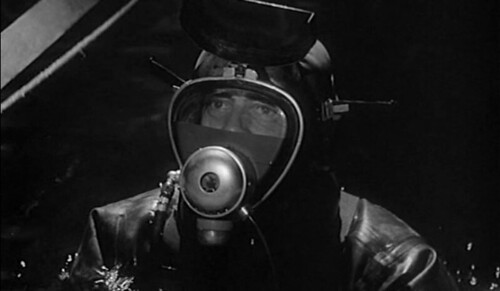
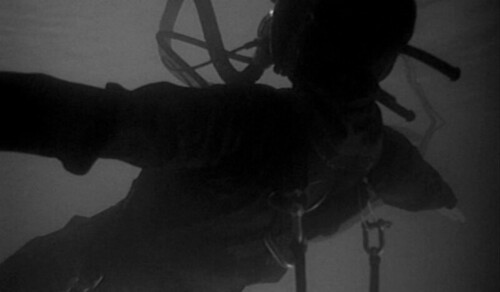
Conventional monster movies always give me the spooks, but I'm only really petrified when the terror in a film seems like it could actually happen - or when the main character is so dreadfully afraid in the film that you become just as afraid yourself. The Mind Benders deals with one of the most frightening experiences that man could suffer through- complete isolation. Isolation from sight, sound, touch, taste, smell and human contact. The experience is made so real, so absolutely horrifying that I actually felt sick to my stomach at one point. Now this might not seem like a selling point, but it is. I was so engulfed in this film that I want to pop the disc in my dvd player again tonight. I want to be with it again, to see it again. I'm not a sadist or anything- the film isn't torture. While it has it's unsettling moments, it is actually incredibly moving and really makes you think.
The film opens with an elderly scientist committing suicide by jumping off of a moving train. Next to his body they find a suitcase filled with cash, apparently the money he was given for leaking top-secret scientific information to the Communists. What seems like a simple open-and-shut case of treason is actually much, much more complicated. The scientist, Dr. Sharpey, was working on a disturbing project called Isolation in which he was attempting to find out what happens to the human brain when all of the senses are taken away. The guinea pigs in the study were Dr. Sharpey himself, and his colleague, Dr. Longman-- played by Dirk Bogarde.
Longman realizes that the only way to prove that Sharpey wasn't the kind of man who would commit treason is to show that once you go through "Isolation" you don't come out the same man. The only way to prove this is to go through Isolation himself. While the plot seems to be about espionage and proving someone's innocence, it really isn't. It's about what makes us human, and how fragile that something is.
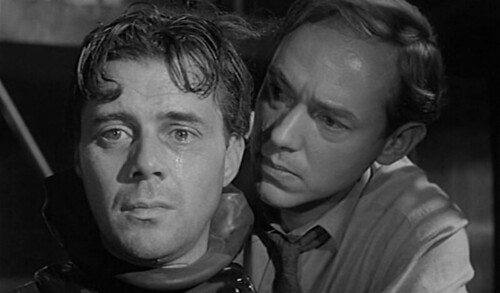
I can't tell you how much I want to go into more detail about the plot and the twists, and how DB's character progresses throughout the film but I think that if I had known any of that before I watched it, the intensity of the movie would have definitely been blunted. You need to see this film fresh for the first time, with no preconceptions and no spoilers, in order to full appreciate it. One thing to look out for, though-- Dirk Bogarde's eyes before and after Isolation. They seem to get darker in color, but they don't. It's not a special effect; it's a cold, icy look -- and it is remarkable.
This was by far, hands down the best DB performance I've seen so far. I don't know how he didn't have a nervous breakdown while acting this part. He is so emotional and intense it is almost incomprehensible. When I first discovered DB back in August, I had no idea how much talent he had-- I thought he was a handsome, skilled actor and that I'd like to see more of his films. I am so glad that I followed through, because I think his might be the single best performance I've seen by an actor in my entire life. It was absolutely brilliant, and I think that it actually enriches my life to have seen him in this movie.
I loved this film so much (can you tell?) that I really wanted to write the most brilliant blog post ever about it, but I'm so tongue tied (or keyboard tied, as it were) that I can't express myself. Good films do this to me, they knock all of the wordiness out and just leave me gaping and staring at the screen. Since I watched it last night, I've gone to sleep, woken up, eaten breakfast, lunch and dinner, worked and had fun. But inside I am still gaping and staring at the screen. It has a hold on me and I think I need to watch it again tonight. I'm sorry, I mean I need to experience it.
***
Netflix has the film in its database, but it doesn't have it available to rent yet. You can buy it on amazon here or on ebay here. It's pretty cheap (about $4) and well worth every penny!!
Or if you're broke & desperate, email me and I'll make you a copy from my tape. I want everyone who's interested to see this movie, it's really one of the best films I've ever watched.
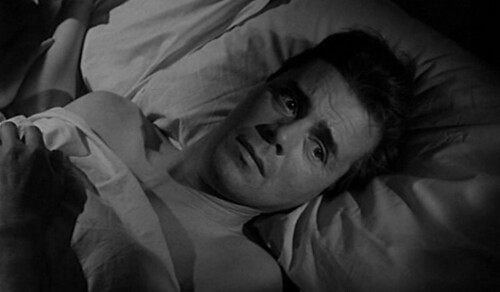
The "after Isolation" eyes
I took over 20 screenshots from the film-- to see the rest, click here.
Whether you are suffering from depression, boredom, the flu or bogardeitis (the excessive desire to watch Dirk Bogarde movies) I have the perfect medicine for you -- The Doctor series.
Made between 1952-1963, The four films in the Doctor series follow a young Doctor Simon Sparrow (DB) as he experiences the ups and downs of joining the medical profession. Each film is a blast with beautiful innuendo and that biting British wit that you don't find in American comedies.
The one thing that can be a bit befuddling is the lack of continuity. The same actors appear in every film, but Dirk Bogarde is the only person who played the same character in all four installments. James Robinson Justice's character Sir Lancelot Spratt (a big, burly and grumpy doctor) appears in three of the films -- but in the second movie he is named Captain Hogg. Simon Sparrow seems to be engaged to a different woman at the end of each film, but she isn't mentioned in the next movie. And while DB is a shy, introverted student who is almost afraid of women in the first three, he is a full-fledged womanizer in the last movie! Maybe the fact that these were released with a span of at least two years between each one, they hoped the audiences would just forget what had happened last time..
Doctor in the House is the first Doctor film, which introduces us to Dr. Sparrow - a first year medical student who is inexperienced in medicine and love. The first one is actually my least favorite. Usually sequels are pitiful, but I think that in this case the series improved with each installment. I attribute that mainly to the script and the fact that the characters were more finely tuned in the later films.
Another reason for the progressive improvement of the series is that Dirk Bogarde was given the opportunity to act in more substantial, challenging films after his first turn as Dr. Sparrow. Up until this point he had been type-cast as seedy young hooligans, often in low budget pictures with so-so scripts. Personally I think he excelled in these roles, but it is obvious that his talent improved tenfold after he was really given the chance to show his acting chops. Doctor in the House was such a rip-roaring success that DB was offered more prestigious roles from then on.
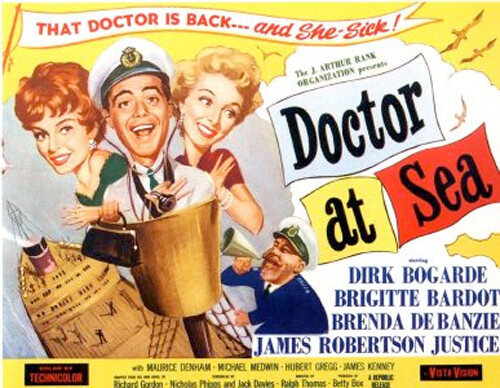
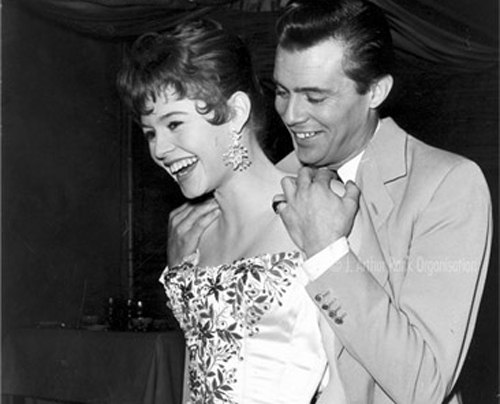
Doctor at Sea is the second film in the series. After being scared away from his previous job by a homely, and overly amorous, woman, Simon Sparrow gets a job as the doctor on a ship. An under-stocked supply cabinet, sea-sickness and reluctant patients are just a handful of the problems that he has to deal with at sea. One particular scene when DB tries to extract a tooth from a scared shipmate is laugh-out-loud hilarious! Of course, his bad sea voyage changes course when a buxom beauty joins them on board. Doctor at Sea stars a really young brunette Brigitte Bardot Bardot as DB's love interest. This was her first English-speaking film, and she sings a really cute song when she makes her entrance.
Don't they look cute together?
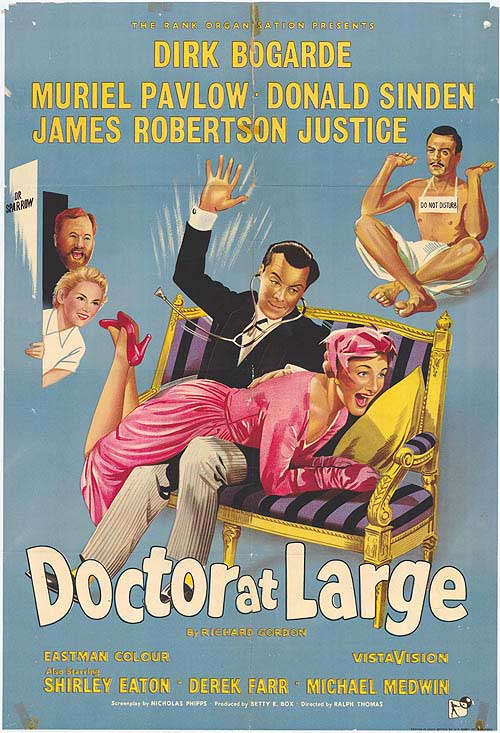
In Doctor at Large we get the first glimpse of Simon Sparrow: the wolf. He's still kind of pathetic at it, but he does convince a woman to spend a night in a country hotel. Granted, things don't go as planned- but he's trying! He doesn't become a bona fide wolf until the last film, when the 1960's are in full swing and staying overnight with your girlfriend is much more acceptable anyway. This film sees Dr. Sparrow through a series of jobs - from a swank doctors office where he treats Maharajahs and movie stars to a small country practice where he is paid with stolen fish. His girlfriend from the first movie is back, but there is no reference to them having ever dated. It's one of the funniest Doctor movies, but the girlfriend thing is kind of confusing.
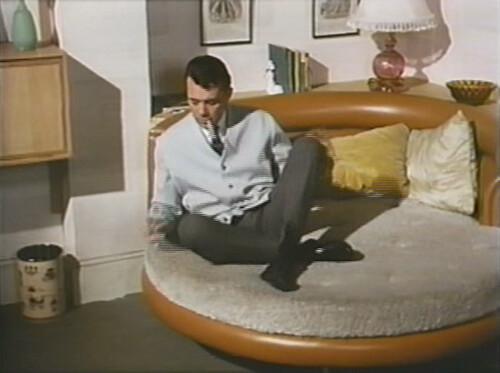
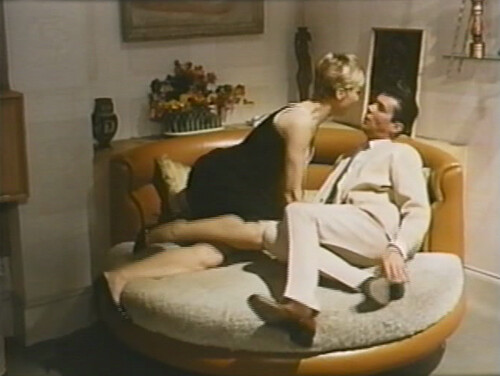
My favorite was Doctor in Distress. You can definitely see that this is now the swinging sixties in London-- the women's outfits are fantastic and Simon Sparrow has THE most awesome couch in history.
The plot revolves around Sir Lancelot Spratt's discovery of love. Now an expert on the subject, Simon Sparrow dispenses advice on how to hook the girl. The story is much more cohesive than the other three films, and rather than just barking and being grumpy all the time, Spratt is quite a teddy bear in this one. Simon Sparrow deals with some issues at the hospital, but the situation which causes the most distress is a dinner party with beautiful, but aggressive, Swedish twins. (Yup, it's the sixties.) The twins are just two of the really fun characters in this movie- it's filled to the brim with great supporting roles. And if you look carefully, Richard Briers (Tom Good from The Good Neighbors, my favorite Brit Com!) plays a student intern in the first few minutes of the film!
The couch!!!
It seems fitting that DB made his last Doctor film the same year that he made The Servant. The Servant represented a new chapter in DB's career-- the roles from here on in were much edgier and avante garde. And so he ended his long stint as a matinee idol by playing the same character that started it all, Doctor Simon Sparrow.
This is the first post in a new series I'm starting called "Celluloid and Canvas," about actors and actresses who were bursting with so much creativity that acting was simply not enough to exhaust all of their talents. Although "canvas" does refer to painting, this also includes filmmakers who sculpted and wrote as well.
First up-- surprise surprise-- is my inspiration for the series, Mr. Quadruple-Threat himself, Dirk Bogarde. Yes, he could act and sing. But did you also know that he was a talented artist?
According to my Fan Star Library biography (I haven't purchased an official biography yet, sue me!)
"On D-Day itself, which was June 6, he was among the first troops to land in Normandy, and as a result of the rather rough crossing of the English Channel his sketch book was rather damp. But he just had to do a bit of sketching, and found a piece of blotting paper which he used instead.
Two of his D-Day sketches were later bought by the British War Museum. Two others went to America."
DB's mother had hoped he would consider studying to become a commercial artist, definitely a more reliable career than acting. Despite his insistence to become an actor, it is obvious from the artwork posted on the Dirk Bogarde Estate website that he certainly had the talent to be a professional artist if he had chosen that path. All of the artwork featured on the site is exceptional, and it displays the same kind of skill that you see in sketches by Picasso or Van Gogh. Some of the drawings are from his wartime service, some are random doodles and some were used to illustrate his several books.
Oh, right-- he also wrote books. Tell me, is there ANYTHING this man could not do??
Today Miriam Hopkins would have been 107 years old.
Out of all the actresses I admire, I think that Miriam Hopkins is the most underrated. Her skill as a serious actress and a comedienne rivaled that of her more famous contemporaries like Bette Davis and Barbara Stanwyck. Like Jean Arthur, she had an unconventional beauty, unique voice and the ability to speak rapid fire dialogue without missing a beat. She made the transition from risque pre code (some of the most risque of that era, if you ask me!) into the more tame post-code films with ease. She was brilliant when playing the leading lady, but was strong enough to hold her own when sharing the top billing with such heavyweights as Kay Francis or Bette Davis.She had enormous range and was capable in every genre -- from her light performances in the Lubitsch comedies Design for Living and Trouble in Paradise, to her melodramatic turns with Bette Davis in Old Acquaintance and The Old Maid, to her oh-so-pre-code roles in Dr. Jekyll and Mr. Hyde and The Story of Temple Drake.
And when her age began to show, Miriam Hopkins seamlessly transitioned into character roles in top notch films. And she continued playing character roles until two years before her death in 1972.
Miriam Hopkins might be remembered now as a bit of a drama-queen, and for her epic feud with Bette Davis. But she was a tremendously talented actress and deserves to be remembered, and respected.
Here is the opening scene from my favorite Miriam Hopkins movie, Design for Living (the whole movie is on YouTube & DVD.. no excuses not to see it!)